Macedonia,  ancient kingdom  centred  on  the
plain in the northeastern corner of the Greek
peninsula,  at  the  head  of  the  Gulf   of
Thermaikos. In the 4th century BC it achieved
hegemony  over Greece and conquered lands  as
far  east as the Indus River, establishing  a
short-lived   empire  that   introduced   the
Hellenistic    Age    of    ancient     Greek
civilization.

  The cultural links of prehistoric Macedonia
were  mainly  with  Greece and   Anatolia.  A
people  of unknown ethnic origins who  called
themselves  Macedonians are known from  about
700  BC, when they pushed eastward from their
home  on the Haliacmon (Aliakmon) River under
the  leadership of King  Perdiccas I and  his
successors.  By  the  5th  century   BC   the
Macedonians  had adopted the  Greek  language
and  had  forged a unified kingdom.  Athenian
control   of   the  coastal  regions   forced
Macedonian rulers to concentrate on  bringing
the  uplands  and  plains of Macedonia  under
their  sway a task finally achieved by  their
king  Amyntas III (reigned c. 393-370/369).

  Two  of  Amyntas'  sons, Alexander  II  and
Perdiccas III, reigned only briefly. Amyntas'
third son, Philip II, assumed control in  the
name  of  Perdiccas' infant heir; but  having
restored  order he made himself king (reigned
359-336)   and   raised   Macedonia   to    a
predominant position in Greece.

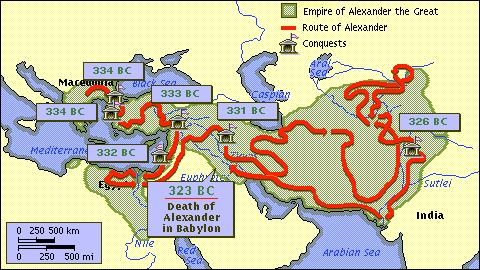
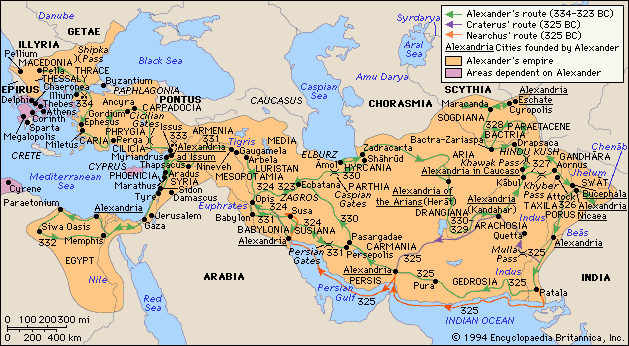
  Philip's  son  Alexander III (reigned  336-
323;  see Alexander the Great) overthrew  the
Achaemenian  (Persian)  Empire  and  expanded
Macedonia's  dominion to the Nile  and  Indus
rivers.  On Alexander's death at Babylon  his
generals divided up the satrapies (provinces)
of  his  empire and used them as bases  in  a
struggle  to acquire the whole. From  321  to
301  warfare was almost continual.  Macedonia
itself remained the heart of the empire,  and
its  possession  (along with the  control  of
Greece)   was  keenly  contested.   Antipater
(Alexander's regent in Europe)  and  his  son
Cassander   managed  to  retain  control   of
Macedonia and Greece until Cassander's  death
(297), which threw Macedonia into civil  war.
After  a six-year rule (294-288) by Demetrius
I  Poliorcetes, Macedonia again fell  into  a
state  of internal confusion, intensified  by
Galatian  marauders from the  north.  In  277
Antigonus  II  Gonatas, the  capable  son  of
Demetrius,  repulsed the  Galatians  and  was
hailed as king by the Macedonian army.  Under
him  the  country achieved a stable  monarchy
the  Antigonid dynasty, which ruled Macedonia
from 277 to 168.

 Under Philip V (reigned 221-179) and his son
Perseus  (reigned 179-168), Macedonia clashed
with  Rome  and lost. (See Macedonian  Wars.)
Under  Roman control Macedonia at first (168-
146)   formed   four  independent   republics
without  common  bonds. In 146,  however,  it
became   a  Roman  province  with  the   four
sections  as administrative units.  Macedonia
remained  the  bulwark  of  Greece,  and  the
northern  frontiers saw frequent  campaigning
against neighbouring tribes. Toward AD 400 it
was  divided into the provinces of  Macedonia
and Macedonia secunda, within the diocese  of
Moesia.

  Alexander's empire became, after his death,
the  scene  of  a  long  struggle  among  his
generals,   most   of  whom,   installed   by
Alexander  as satraps, aimed at  breaking  up
the  empire and creating realms of their own.
For  more  than  40 years (323-280  BC)  they
battled,  with  shiftings of territories  and
power;   and   their   conflicts   laid   the
foundations of a new type of monarchial ruler
and bureaucratic state and a new civilization
of  multiple nations united culturally by the
Greek language. The three leading realms  the
Macedonian  (north of Greece),  the  Seleucid
(reaching  from  Palestine  and  Anatolia  to
Persia), and the Ptolemaic (centred in Egypt)
thereafter maintained a balance of power. The
ensuing  wars and foreign policy signified  a
constant  probing  of that balance  and  were
concentrated  mainly on the border  areas  of
Syria,  Asia  Minor, and the  Aegean.  Greece
itself in the 3rd century BC saw the rise  of
two   leagues,  the   Aetolian  (which   held
central and northern Greece) and the  Achaean
(which held all the Peloponnese except Sparta
and  Elis);  they  gradually  extended  their
power  and rivalry and weakened the  position
of Macedonia.

  Culturally the period from about 280 to 160
BC   was   highly  creative,  producing   the
historian Polybius, the mathematician Euclid,
the  astronomers Aristarchus, Hipparchus, and
Seleucus,  and  the geographers  Eratosthenes
and   Poseidonius.  It  was  the  philosophic
period  of the Epicureans and Stoics and  the
artistic  period that left to posterity  such
now-famous sculptures as the "Venus de Milo,"
the   "Victory   of  Samothrace,"   and   the
"Laocoon."  The   Museum at Alexandria,  with
its  large library, became the meeting  place
of  scholars  and writers.  Callimachus,  who
was the leading Greek poet of the 3rd century
BC,  was responsible for the catalog  of  the
library. Other cities besides Alexandria also
had substantial libraries.

  The decline of the Hellenistic states began
in  the  late  3rd century BC and accelerated
after  160  BC. It was the moment  when  "the
clouds  from the West" began to threaten  the
Hellenistic world and its balance  of  power.
Rome,  by  defeating  the  Illyrian  pirates,
ruled the Adriatic Sea and became Macedonia's
neighbour. In a succession of Macedonian Wars
(214-205, 200-196, 171-168, 149-148 BC), Rome
defeated and finally conquered Macedonia  and
Greece. By this time the Seleucid empire  had
shrunk as a result of dismemberment and  loss
of   territories  and  allegiances;  it   was
practically   confined  to  Mesopotamia   and
Syria,  with a weak hold on the seven  "upper
provinces" in the east. A new power,  Pontus,
on  the southern coast of the Black Sea,  was
flexing  its  muscles  under  Mithradates  VI
Eupator.  Rome stepped in, and,  after  three
Mithradatic  Wars (88-85, 83-82,  74-63  BC),
the  Seleucid  empire ceased to exist.  Syria
and  Bithynia  (with western  Pontus)  became
Roman   provinces,   and  client-kings   were
recognized in Armenia, Commagene, Cappadocia,
and elsewhere.

Egypt   under  the  Ptolemys  limped   along,
gradually    surrendering   to   Rome    such
territories as Cyrene (96 BC). The final  act
of  the  Hellenistic Age came when Egypt  was
drawn  into  the  civil war between  Octavian
(the  future Augustus) and Mark Antony. After
the  deaths  of  Antony and Cleopatra,  Egypt
became  a  province of the Roman  Empire  (30
BC).

  Nothing  shows the personality of Alexander
the  Great more clearly than the way in which
people who had seemed pygmies at his side now
became  leaders  of  the world  he  had  left
behind.  Blood still counted: the  only  male
relative,  a  mentally impaired, illegitimate
son  of Philip, was proclaimed king as Philip
III  Arrhidaeus (c. 358-317),  together  with
Rhoxane's  son  Alexander IV (323-310),  born
after his father's death in August; both were
mere  figureheads. For the  moment  Antipater
was  confirmed in authority in   Macedon  and
Greece. At  Babylon power was shared  by  two
senior  officers, Perdiccas (c. 365-321)  and
Craterus  (c.  370-321). By  common  consent,
Alexander's ongoing plans were abandoned. His
generals had to be content with the office of
governor.  Antigonus Monophthalmos ("The One-
eyed";  c. 382-301), like Antipater, was  not
in  Babylon at the time of Alexander's  death
in  323.  For  almost 10 years  he  had  been
governing  Phrygia and had  shown  himself  a
brave  soldier  and competent  administrator.
His  firmness and tact were popular with  the
Greek cities. Of the generals in Babylon,  it
was  Ptolemy (c. 367/366-283) who  calculated
from the first that the empire would not hold
together.   He   secured  for   himself   the
governorship  of Egypt, where he  aspired  to
set up an independent kingdom. Lysimachus (c.
360-281)   was  given  the  less   attractive
assignment  of governing Thrace. Two  of  the
others, noted for their physical and military
prowess,  Leonnatus and Seleucus,  waited  on
events.  The soldiers discounted  Eumenes  of
Cardia, who bore the main responsibility  for
civil  administration, but he knew more about
the empire than anyone else.

  An  uprising by Greek mercenaries  who  had
settled  in Bactria but wanted to  return  to
Greece was crushed. Trouble in Greece, led by
the  Athenians  and aimed at  liberating  the
cities from Macedonian garrisons, was tougher
to control. Sparta refused to participate, as
did  the  islands, but a coalition of  Athens
with   Argos,  Sicyon,  Elis,  and  Messenia,
supported   by   Boeotians,  Aetolians,   and
Thessalians,  was a formidable  challenge  to
Antipater's  authority. For a time  Antipater
was hard-pressed in Lamia (the war of 323-322
is   known  as  the  Lamian  War).  Leonnatus
intervened, nominally in support but in  fact
ambitious to usurp Antipater's power; he  was
killed   in  action,  however.  In  the   end
Antipater   won,   Athens  capitulated,   and
Demosthenes  (the voice and symbol  of  anti-
Macedonian   feeling)   committed    suicide.
Antipater  reestablished Macedonian authority
autocratically,  with  no  nonsense  about  a
"free" League of Corinth.

  The story of the jockeying for power during
the  next  two  decades or so is inordinately
complex.  First Perdiccas, governing  in  the
name  of  the two kings with the  support  of
Eumenes,  was charged with personal  ambition
and   was   assassinated.  The  armies   made
Antipater regent (Craterus had been killed in
battle), and Antigonus, with Antipater's  son
Cassander  (c. 358-297) as second-in-command,
was  placed in charge of the armies in  Asia.
Ptolemy was secure in Egypt; Seleucus (c. 358-
281), governor of Babylon, and Lysimachus  in
Thrace  continued  to  watch  and  wait;  and
Eumenes,  a  non-Macedonian  with  a  fortune
behind  him,  could claim  to  represent  the
kings  against the ambitions of generals  and
governors.

   Then,  in  319,  Antipater  died  and  was
succeeded by a senior commander but maladroit
politician named  Polyperchon, who  tried  to
win  the  Greeks  of the mainland  by  a  new
proclamation of their liberties.  The  result
was that the Athenians used their freedom  to
execute  the  pro-Macedonians, including  the
worthy  but compromising Phocion. War  flared
up.   Eumenes,   allied   with   Polyperchon,
challenged Antigonus and secured Babylon, but
he  was  betrayed and killed in 316. Seleucus
escaped to Egypt. Polyperchon's position  was
weak, and he was soon ousted by the able, up-
and-coming  Cassander. In becoming master  of
Macedon and most of Greece, Cassander rebuilt
Thebes and put the Aristotelian Demetrius  of
Phalerum   in  charge  of  Athens.  Olympias,
Alexander  the Great's terrible  mother,  had
eliminated Philip III. Cassander had her  put
to death, while keeping Rhoxane and Alexander
IV under his protection or guard.

 Antigonus was now the dominant figure of the
old    brigade.   Cassander,   Ptolemy,   and
Lysimachus  formed a coalition  against  him.
For   four   years  (315-311)   they   fought
indecisively.   Antigonus   showed    himself
energetic, resourceful, and imaginative,  but
he could not strike a decisive blow. The only
major  change came in the brilliant  coup  by
which   Seleucus  succeeded   in   recovering
Babylon.  In 311 the four leaders  agreed  to
divide the world, leaving Ptolemy with  Egypt
and  Cyprus, Antigonus with Asia,  Lysimachus
with Thrace, and Cassander with Macedonia and
Greece,  but only until Alexander IV came  of
age in 305. Seleucus was left out.

  Royal blood, however, was quickly forgotten
in  the  pursuit of power. Cassander murdered
Rhoxane  and  young Alexander  in  310,  soon
after  Antigonus had vainly  tried  to  crush
Seleucus.  Seleucus, however, held  on  to  a
damaged  Babylon  and the eastern  provinces,
except  for India, which he had to  yield  to
the  Indian king Chandragupta. Antigonus  now
had  the  effective support of his  brilliant
son     Demetrius   (336-283),    known    as
Poliorcetes,  or  Besieger,  who  ousted  the
other  Demetrius and restored  the  democracy
and  eventually the League of Corinth; he was
hymned  with  divine honours  and  given  the
Parthenon as his palace. Demetrius,  also  in
306,  crushed Ptolemy in a naval  battle  and
secured  Cyprus  and the  Aegean,  though  he
failed in a famous siege of Rhodes (305-304).
Antigonus   and   Demetrius  now   proclaimed
themselves  joint  kings  in  succession   to
Alexander.  Antigonus,  however,  failed   to
conquer Egypt, and the other rulers also took
the  title  of  king. Cassander,  Lysimachus,
Seleucus,  and  Ptolemy  formed  an  alliance
against Antigonus and Demetrius, and at Ipsus
in  301 the allies, with the help of a  force
of  elephants brought from India by Seleucus,
defeated   and  killed  Antigonus.  Demetrius
escaped, retaining Tyre and Sidon and command
of the sea. Lysimachus took large portions of
Anatolia;   Seleucus  assumed  control   over
Mesopotamia and Syria, except for a  part  in
the  south occupied de facto by Ptolemy;  and
Cassander  was  content  with  Macedonia  and
parts of Greece.

Cassander,  who was a statesman, had  founded
two    great    cities,    Cassandreia    and
Thessalonica,  as well as rebuilding  Thebes.
His  death  in  297  was a  prelude  to  more
disturbances.  Demetrius  conquered  most  of
Greece  and secured Macedonia in 294, but  he
was  ousted in 288 by Lysimachus in  alliance
with   King   Pyrrhus  of  Epirus  (319-272).
Demetrius now concentrated all his forces  on
winning  Asia and all but succeeded. He  fell
ill,  however, and surrendered  to  Seleucus,
who  gave  him  every  opportunity  to  drink
himself  to death. The stage was  set  for  a
confrontation    between    Lysimachus    and
Seleucus.

Ptolemy   gained  command  of  the   sea   by
Demetrius' fall. He died in his bed, the only
one  of Alexander's successors to do so,  and
was  succeeded peacefully by his son  Ptolemy
II  Philadelphus (308-246). However, a son by
his   first   wife,  Ptolemy  Ceraunus,   the
Thunderbolt  (grandson  of  Antipater),   was
stirring the waters round Lysimachus, and the
latter  soon lost support. Seleucus  defeated
and   killed   Lysimachus,  and   Alexander's
empire,  except for Egypt, seemed to  be  his
for  the  asking. Lysimachus' army,  however,
supported Ceraunus, who assassinated Seleucus
in 281. Seleucus' son by a Sogdian noblewoman
succeeded  him  as Antiochus I (324-261).  In
Greece  proper  the  strongest  powers   were
Antigonus  Gonatas (c. 320-239), son  of  the
brilliant Demetrius and himself a man of high
character, ability, and culture, and Pyrrhus,
king  of Epirus. Pyrrhus was about to  embark
on his ill-starred expedition to Italy, where
he soundly defeated the growing power of Rome
but at an enormous cost to himself.

At  this  point, migrating  Celts  under  the
command  of  Bolgius and  Brennus  caused  an
added  complication, not least by the  defeat
and  death  of Ceraunus. Brennus pushed  down
into   Greece   but  was  repulsed   by   the
Aetolians. The dangers posed by the  invading
Celts  led,  in  279,  to  a  treaty  between
Antigonus  and Antiochus, who agreed  not  to
interfere   in  one  another's   spheres   of
influence.  Each won a decisive victory  over
the  Celtic invaders, who eventually  settled
in  Serbia,  Thrace, and Galatia  in  central
Anatolia.   Antigonus  was  able  to   secure
Macedonia.  Lysimachus'  kingdom  was   never
revived.  The  three centres  of  power  were
Macedonia, Syria, and Egypt.
Back Home
